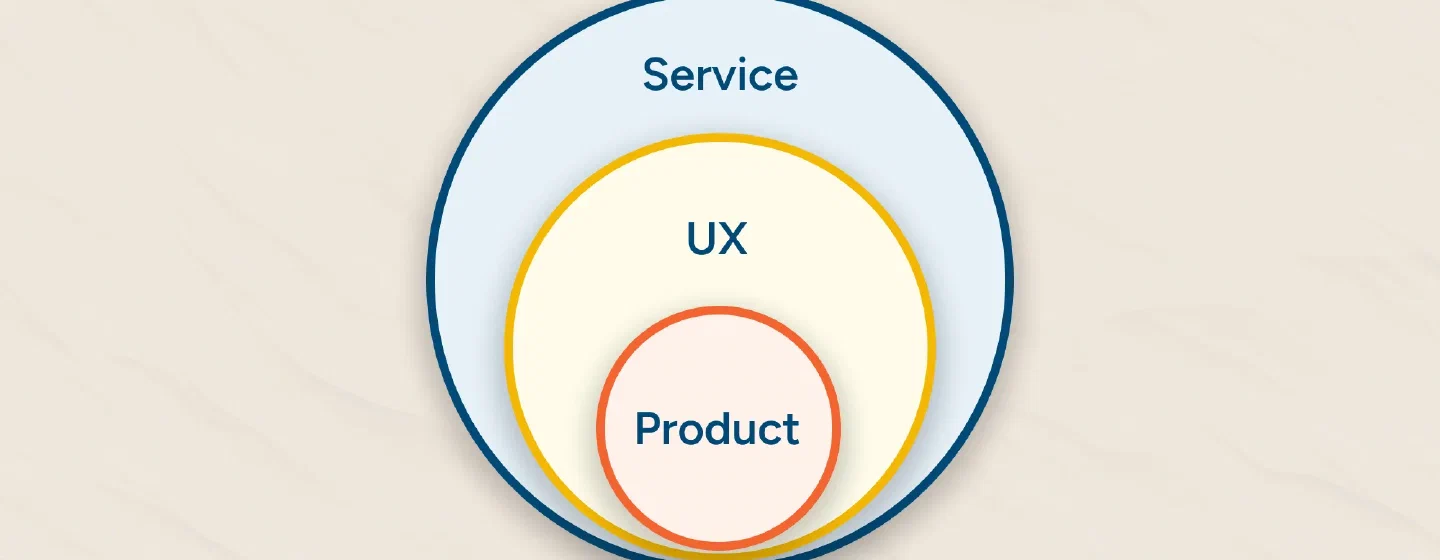
UX Was Never Just About Interfaces. Here’s What Happened.
I did not know the term “UX design” when I started my master’s in Interaction Design at Université Laval (called Multimedia Design at the time). What drew me in was something Éric Kavanagh, the program director, said to me before submitting my application: it is design with a capital D. We are here to solve ill-defined problems.
That framing resonated deeply with me. I came from a business bachelor’s degree in marketing, and I had seen firsthand how organizations struggled to connect what they were building with what people needed. The idea that design could operate at that level (strategic, systemic, human) was exactly what I was looking for.
I learned the term “UX design” from my colleagues at the university. Once I knew it existed, I pursued it. But like most junior UX designers at the time, I started by making interfaces. It was where the work was, where the entry points were. I strived for the capital D, but I learned the craft first.
I have spent the years since trying to reconcile those two things and I have come to believe that the tension between them is not personal. It is structural. It is built into how the discipline evolved.
Don Norman’s Original Vision
In 1993, Don Norman joined Apple with a title nobody had seen before: User Experience Architect. He coined the term himself, and his reasoning was deliberate. In his own words:
“I invented the term because I thought human interface and usability were too narrow. I wanted to cover all aspects of the person’s experience with a system, including industrial design, graphics, the interface, the physical interaction and the manual.” — Don Norman
The person who invented UX said it was supposed to cover everything. Not just screens. Not just interfaces. The full human experience of interacting with a system (physical, digital, cognitive, emotional, organizational).
Thirty years later, most job postings for UX designers are looking for someone who can make an app look good and run cleanly. Something happened along the way.
How UX Got Narrowed
The narrowing of UX was not malicious. It was the predictable result of a discipline scaling faster than its foundations could travel.
In the early 2000s, the web exploded. Companies needed people to design websites and digital interfaces, fast. Graphic designers and web designers were the closest available talent. They moved into digital product work, brought their craft skills with them, and gradually adopted the UX title. The title was not necessarily wrong. They were designing experiences. But the research foundations, the strategic thinking, the system perspective that Norman had in mind did not always travel with the job title.
Then came the compensation dynamic. UX roles commanded higher salaries than graphic design or web design roles. For many practitioners, adopting the UX title came with a meaningful pay increase, without necessarily a corresponding change in the nature of the work being done. This was not cynical on the part of individuals. It reflected a genuine market signal: companies were paying more for UX, and the supply of people willing to call themselves UX designers grew accordingly. The problem is that the market was not always equipped to evaluate whether what it was getting matched what it was paying for.
There is also an inherent weakness in a term that is too broad. Norman’s original vision was expansive enough to cover almost everything which made it difficult to defend against adoption by practitioners whose work covered only a part of it. A term that means everything risks meaning nothing in practice. The market filled that vacuum with a narrower, more legible definition: UX means digital interfaces.
Then came the bootcamp era, which accelerated all of this. Programs promising to turn anyone into a UX designer in twelve weeks produced graduates who could produce the artifacts of UX work (wireframes, personas, journey maps) without necessarily having the research and strategic foundations those artifacts are supposed to rest on. The output looked like UX. It was not always UX in Norman’s sense.
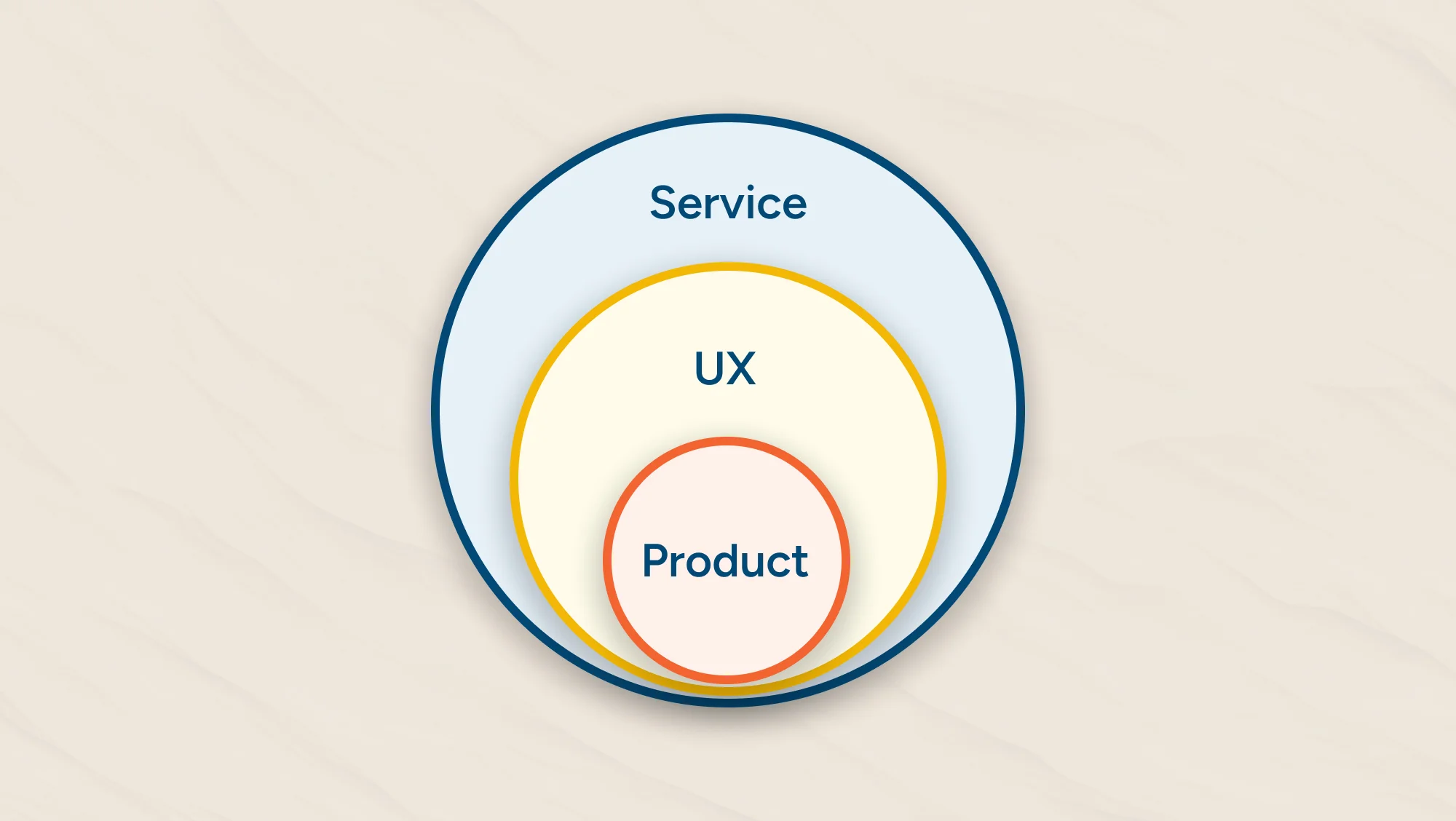 Three disciplines doing what was originally supposed to be one.
The Product Designer Detour
As the gap between what UX was supposed to mean and what it had come to mean in practice became more visible, a new title emerged to try to resolve it: Product Designer.
The intention, broadly, was to signal something more integrated than a UI designer but more grounded in product thinking than the strategic UX role. It gained traction in the tech startup world, where designers were expected to work closely with product managers and engineers across the full product lifecycle.
As Fast Company noted in a recent piece on design titles, in an era “where design is being asked to operate at the intersection of strategy, systems and human behaviour, ambiguous titles are not a minor administrative inconvenience”. Product Designer attempted to solve this, but introduced its own ambiguities.
In my view, the term Product Designer creates its own constraints. Industrial designers have used the term “product designer” for decades to describe the design of physical objects. Reclaiming it for digital work creates genuine confusion at the boundaries. More significantly, framing a designer’s role around “the product” implicitly ties their scope to what the company already delivers; keeping them within the boundaries of a defined artifact rather than the broader problem the artifact is meant to solve. It subtly positions design as a product function rather than a strategic one.
None of this is a criticism of the many talented practitioners who carry the Product Designer title. The work is real and valuable. The question is whether the label serves the discipline or constrains it.
The Service Design Response
It is not a coincidence that service design gained significant momentum in the recent years.
Service design as a formal discipline actually predates UX. Lynn Shostack coined the term in 1982, a decade before Norman invented UX, in a Harvard Business Review article arguing that services, not just products, could and should be deliberately designed. But its rise as a sought-after practice in organizations corresponds almost exactly with the period when UX had become predominantly associated with digital interfaces.
As one analysis of the relationship between the two disciplines observed, when UX designers do apply their skills to service-level problems, “Friction occurs between the two roles, and they are entering the realms of what is coined Service Design.” Service design stepped into the strategic and holistic territory that UX had vacated in the market’s perception.
The Nielsen Norman Group frames it this way: “User experience is focused on what the end user encounters, whereas service design is focused on how that user experience is internally created.” Two disciplines. Two sets of practitioners. Two budget lines. For what was originally supposed to be one integrated practice.
The irony is that Norman’s original vision of UX covering all aspects of a person’s experience with a system, including the organizational context and the full journey is essentially what service design describes today. We invented a new label to reclaim the territory the original label had lost.
And as Arne van Oosterom has observed, service design itself is now facing a version of the same problem; drifting toward digital experience design and away from its own holistic origins. The pattern repeats.
What This Means in Practice
This is not an academic debate. It has real consequences for organizations trying to improve their products and services.
When a company says “We need UX help,” they are usually describing a symptom: the app is confusing, the conversion rate is low, users are dropping off at a specific step. They have diagnosed the problem as an interface problem, and they are looking for an interface solution.
But interface problems are often downstream of something else entirely. The real problem might be that the product is solving the wrong problem for the wrong people. That the service promise does not match the service reality. That different parts of the organization have different and conflicting ideas about what the product is supposed to do for its users. That nobody has talked to users in a meaningful way in years.
These are not problems a better wireframe will fix. They require the broader, more strategic practice that UX was always supposed to be before the market narrowed it.
This is why, in my own practice, I resist framing UX as a discrete phase that happens after strategy and before development. Real UX, Norman’s UX, starts much earlier. It is present in the strategic decisions about what to build and for whom. It asks not just “is this interface usable?” but “does this product or even the organization serve the people it was designed for, and does it do so in a way that is coherent with the business goals behind it?”
That is a much harder question. It is also the right one.
And it is, I think, what Éric Kavanagh meant by design with a capital D.
Which UX Are You Hiring For?
When you hire for UX today, or engage a UX consultant, it is worth asking which UX you are looking for:
- Someone to make your existing product more usable and polished?
- Someone to research your users and surface what they actually need?
- Someone to help you understand whether your product is solving the right problem in the first place?
- Someone to map the full-service ecosystem and find where value is being lost between touchpoints?
These are different questions. They require different skills, different experience, and frankly different conversations. The fact that they can all be answered by someone with “UX” in their title is part of the problem.
Don Norman invented a term broad enough to cover all of them. The market made it narrower. The good news is that the original vision is still available; it just requires knowing what to ask for.
About the author
Louis-Philippe Bellerose
Founder and Principal Consultant